
Verbs are action words. Every complete sentence needs a verb.
Here are some high-frequency Spanish verbs you’ll absolutely need to know, along with printable charts and practice tools to help you study and actually use them in real life. These are the verbs that show up constantly in everyday conversation — the kinds of words locals use all the time but many students never fully master.
Getting Started with Spanish Verbs
If you want to speak Spanish in your daily life — order food, make friends, understand conversations, survive a Costa Rican bus station, or finally understand what your neighbors are saying — verbs are where everything begins.
Verbs are action words. They tell you what someone is doing, feeling, thinking, wanting, or becoming.
trabajar → to work
comer → to eat
dormir → to sleep
jugar → to play
manejar → to drive
The good news is that Spanish verbs follow patterns. Once you begin seeing those patterns, the language becomes much easier.

-
![]()
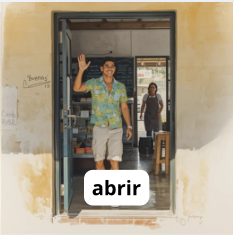
to open
-
![]()
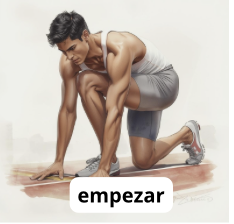
to start
-
![]()
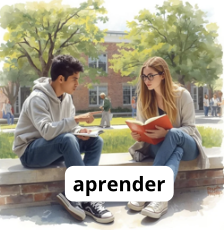
to learn
-
![]()
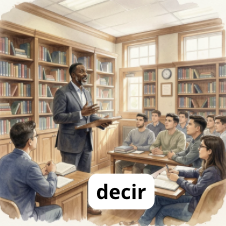
to say
-
![]()
to buy
-
![]()
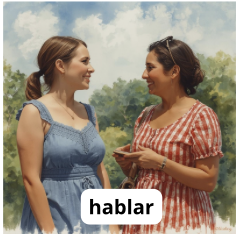
to talk

How Verbs WorkHow Verbs Work
Conjugation — changing a verb to match who is doing the action, when it’s happening, and sometimes how it’s being expressed.
Example: vengo, viene, venimos all come from the verb venir.
Tense — when the action happens.
Present: vengo (I come / I am coming)
Past: vine (I came)
Future: vendré (I will come)
Mood — the feeling or intention behind the verb.
Indicative = facts/reality
Usted viene mañana.
Subjunctive = wishes, doubt, emotion, possibility
Espero que usted venga mañana.
Imperative = commands
¡Venga acá!
Why Spanish Verbs Get Weird
Most students assume irregular verbs are just random acts of cruelty created by language teachers. And honestly, at first glance, the evidence supports this theory.
A perfectly reasonable verb like hablar behaves itself. You learn a pattern, repeat it a few times, and begin feeling cautiously optimistic about your future in Spanish. Then along comes venir.
Vengo.
Vine.
Vendré.
Venga.
Now it looks like four entirely different verbs sharing an apartment.
But the strange thing is that irregular verbs are usually irregular for a reason. They tend to be the oldest, most overused words in the language — the verbs people have repeated constantly for centuries:
to go
to come
to have
to be
to want
And words that get used millions of times eventually wear down.
Sounds shift. Syllables disappear. People shorten things because they’re busy, tired, emotional, distracted, or trying to speak quickly.
Languages evolve the same way cities do. The busiest roads crack first.
Once students begin seeing verbs historically instead of mechanically, Spanish starts making much more sense. The patterns become easier to notice because the language no longer feels random.
You stop memorizing isolated charts and start recognizing families of sounds and structures that developed over time.
And this is usually the point when Spanish becomes genuinely fascinating. Hidden inside everyday conversation are traces of:
ancient Latin
migration
trade routes
regional accents
social class
habit
human behavior
stretching back thousands of years.
Which means that every time someone in Costa Rica says venga acá, they are also — in a very indirect and accidental way — participating in one of the longest continuous stories human beings have ever told.
What is a verb, and why should you care?
VERBS END IN -AR, -ER, OR -IR

Most Spanish verbs belong to one of these three groups.
- AR VERBS
trabajar → to work
jugar → to play
limpiar → to clean
visitar → to visit
pegar → to stick / hit
regar → to water plants
congelar → to freeze
2.-ER VERBS
comer → to eat
beber → to drink
aprender → to learn
3. -IR VERBS
dormir → to sleep
oír → to hear
venir → to come
batir → to mix / beat
4. IRREGULAR VERBS
Some very common verbs do not follow normal patterns.
ir → to go
ser → to be
estar → to be
tener → to have
haber → to have
These are some of the most important verbs in Spanish, so students learn them little by little over time.
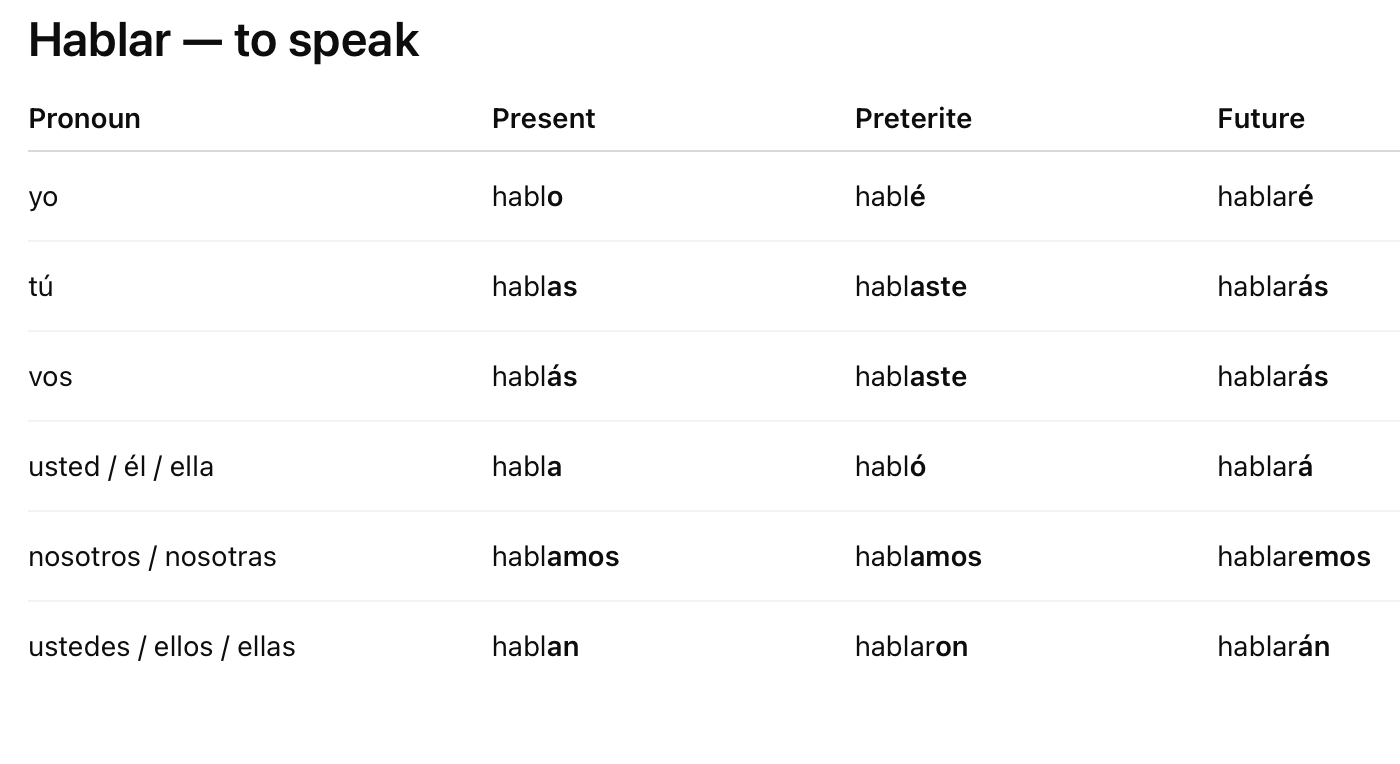
Regular - Ar Verb Endings
-
![]()
Hablar - to speak
-
![]()
The Echo Project
-
![]()
The Brightline Project
-
![]()
The Northgrid Project



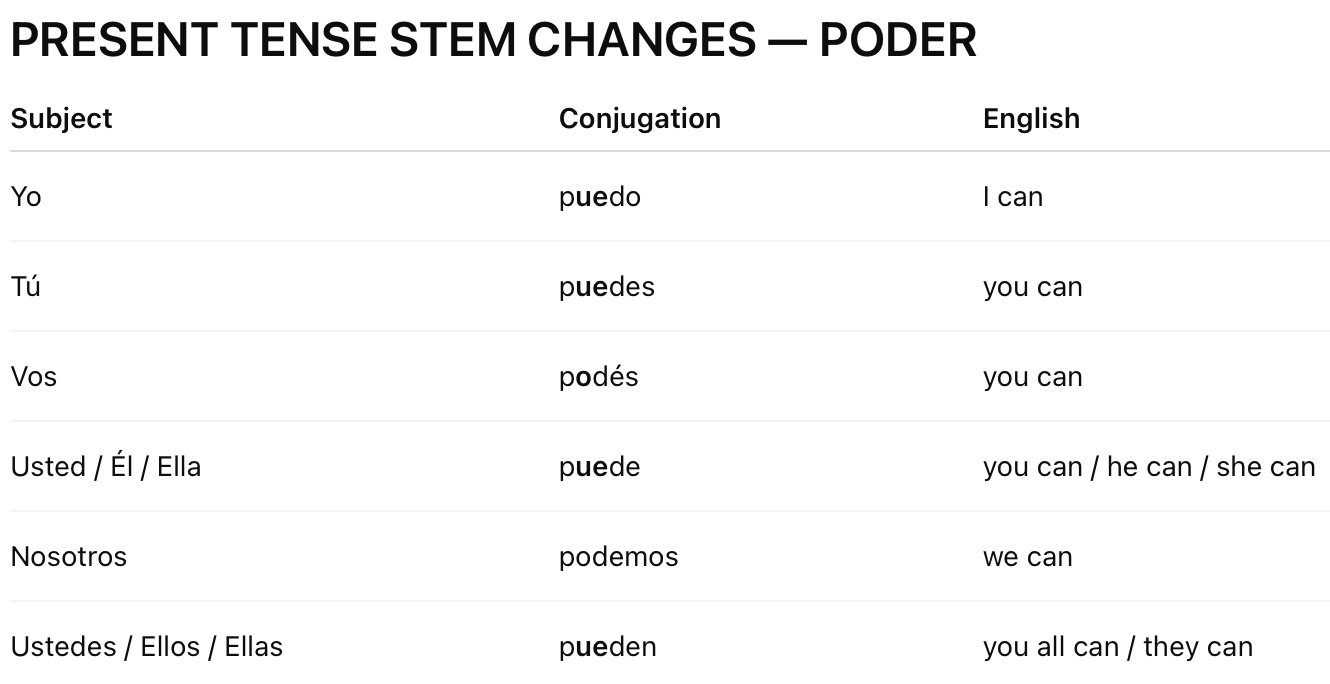
STEM-CHANGING VERBSSTEM-CHANGING VERBS
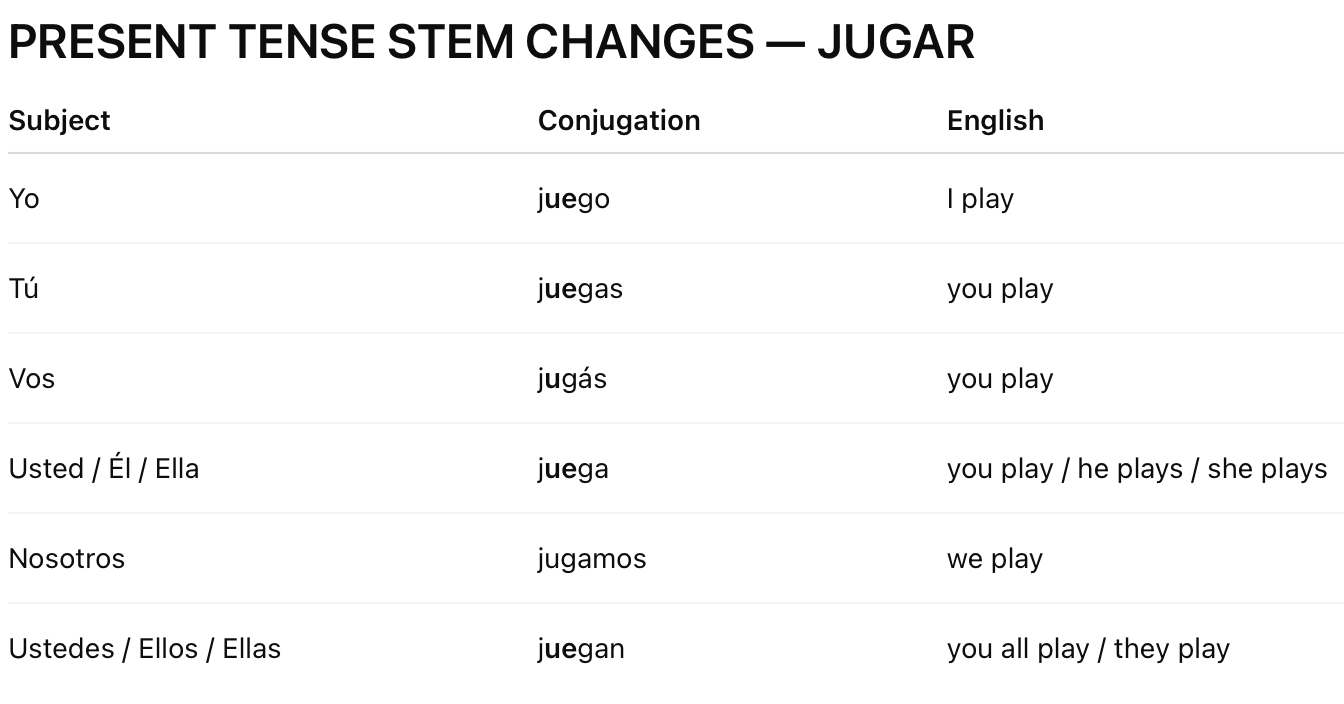
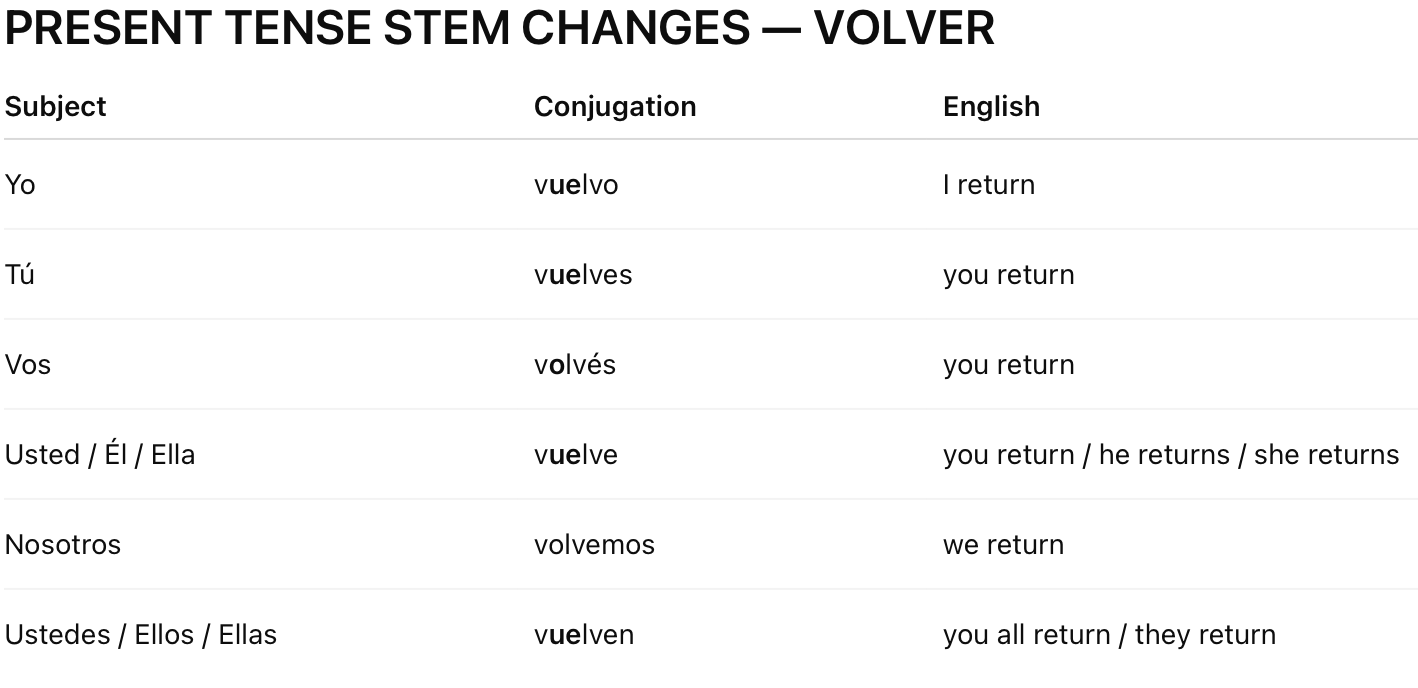
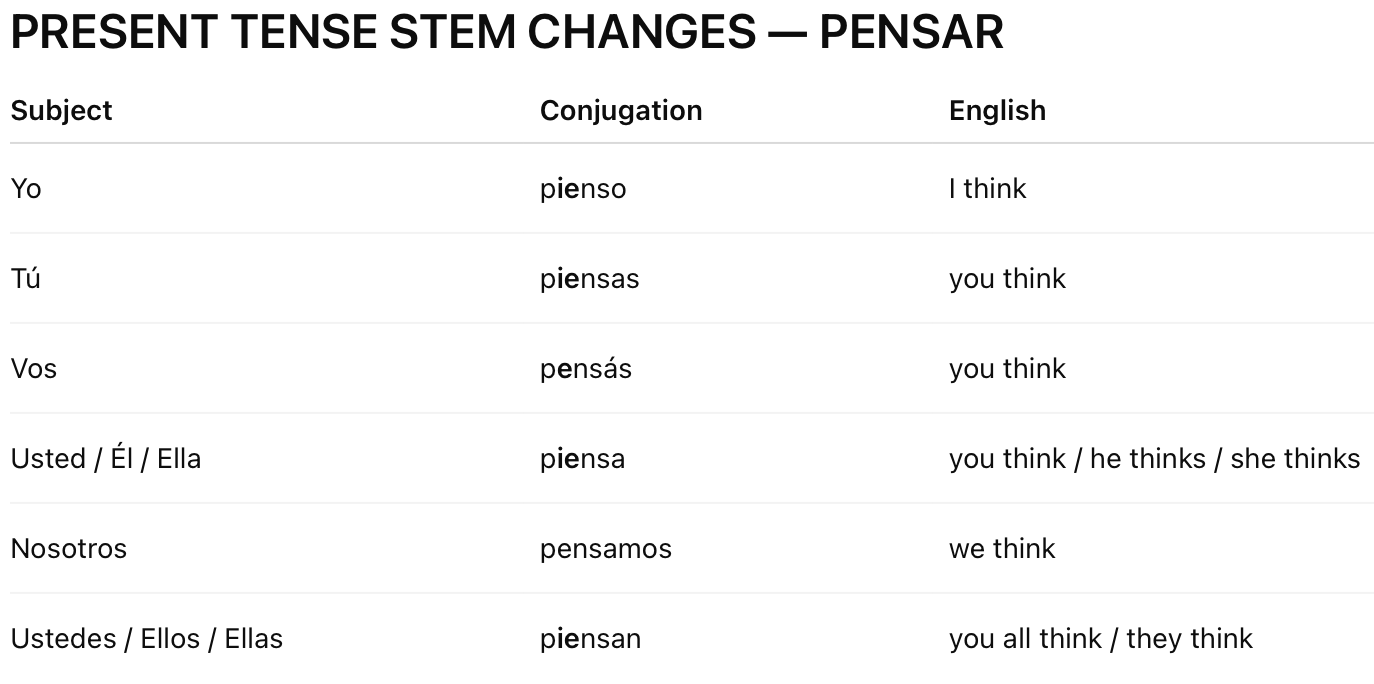
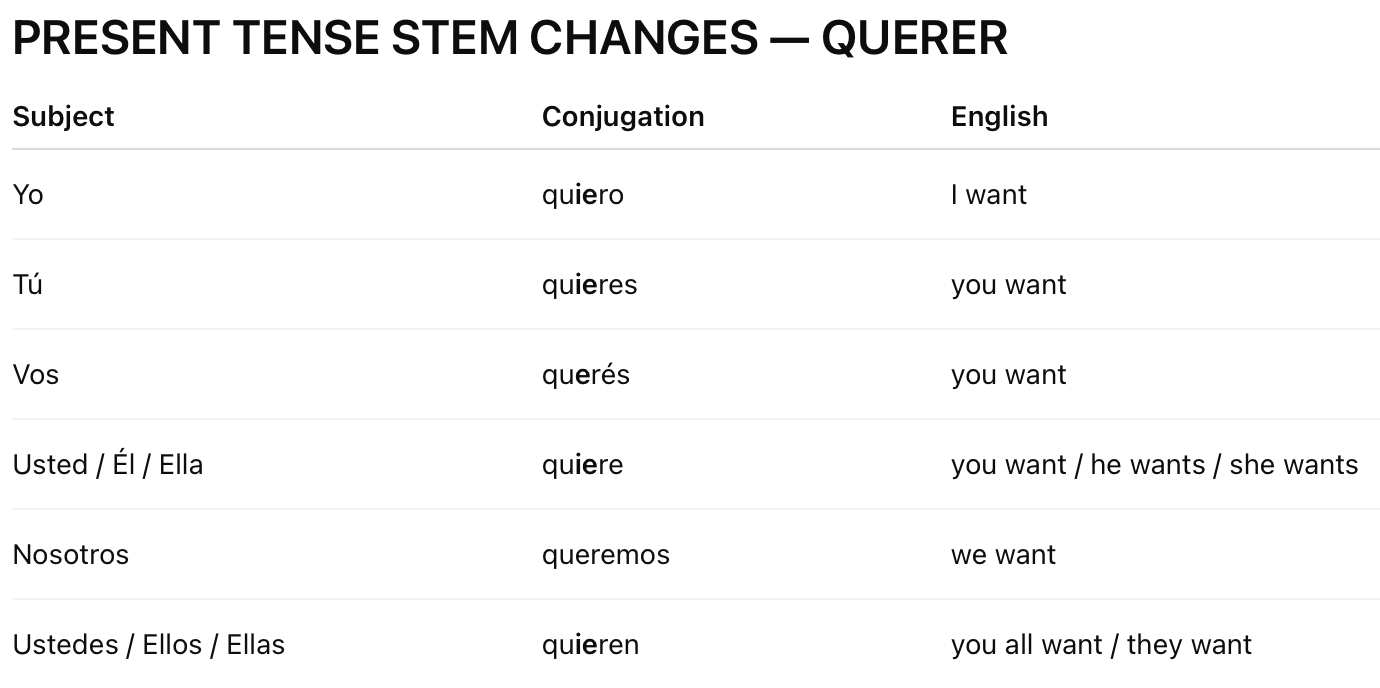
Stem-changing verbs are one of the moments where students usually decide Spanish is either beautifully logical or completely unhinged. Sometimes both within the same afternoon.
On paper, the rule sounds simple enough: certain verbs change a vowel in the middle of the word when conjugated.
dormir → duermo
jugar → juego
venir → viene
But most students immediately ask the correct question:
Why?
And the answer has everything to do with how real people actually speak.
Spanish evolved from spoken Latin, not from a committee designing a perfect system to confuse learners. For centuries, ordinary people reshaped words through repetition, speed, accent, stress, migration, laziness, regional habits, and the universal human tendency to shorten anything said too often. The language was molded not by grammar books but by exhausted farmers, merchants, parents, sailors, children, and people yelling across rooms.
Stem changes are part of that history.
In many common verbs, the stressed vowel — the syllable your voice naturally leans on — gradually shifted in pronunciation over time. Certain vowels stretched. Others softened. Some drifted into entirely new sounds. Eventually those spoken habits became permanent.
That is why:
o often changes to ue
e often changes to ie
sometimes e changes to i
Once you notice the stress pattern, the system suddenly becomes far less mysterious.
Look carefully at these forms:
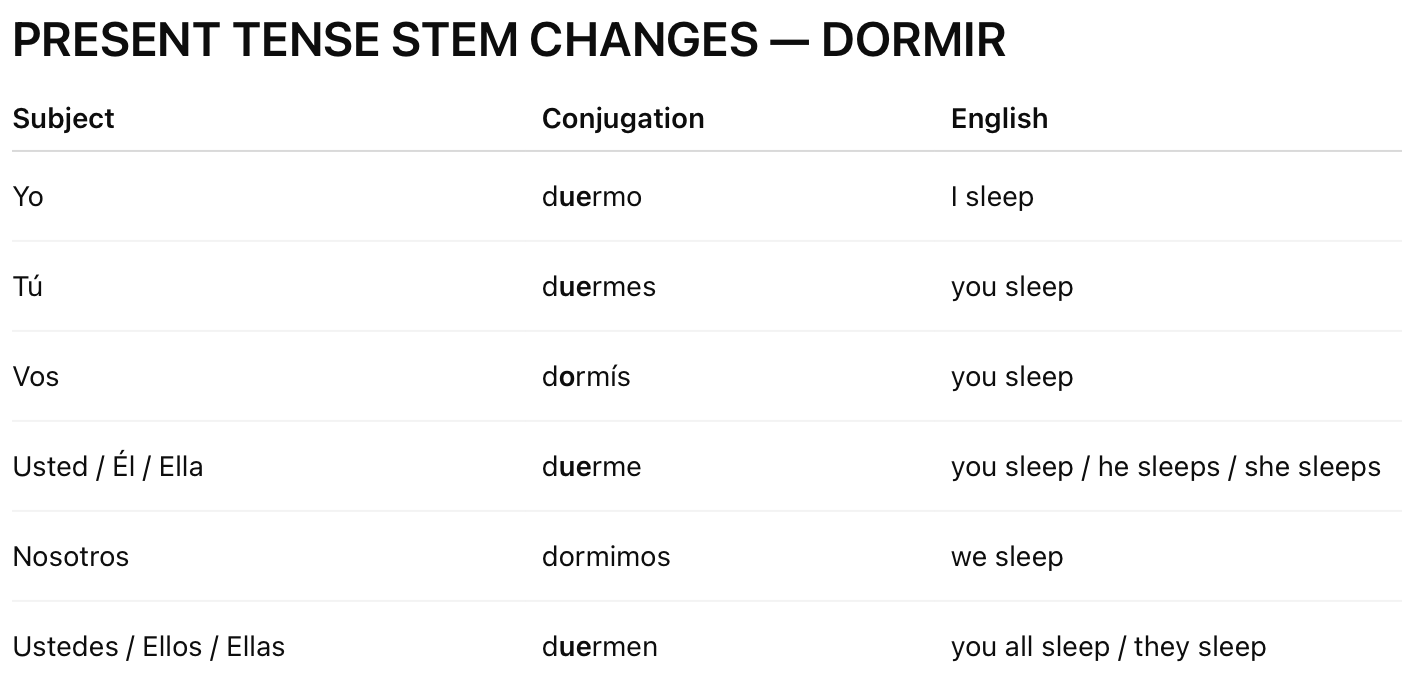
duermo
duerme
duermen
dormimos
The stem change disappears in nosotros because the stress moves to a different syllable. The vowel is no longer under pressure, so it relaxes back into its original form.
This is the sort of thing native speakers never consciously think about, in the same way English speakers rarely stop to analyze why “go” becomes “went,” which is objectively one of the strangest decisions any language has ever made.
This is especially important for students learning Costa Rican Spanish, because spoken Costa Rican Spanish is very melodic. The placement of stress changes how words sound and flow together naturally. Costa Ricans constantly smooth words together in conversation, soften certain consonants, shorten others, and rely heavily on natural speech rhythm. The language lives as much in the mouth and ear as it does on the page.
Which is why memorizing charts alone rarely works for long.
-
![]()
Dormir - to sleep
-
![]()
Jugar - to play
-
![]()
Volver - to return
-
![]()
Pensar - to think
-
![]()
Querer- to want
-
![]()
Poder - to be able to
Our StoryWhat is Conjugation?
Conjugation means changing the verb so it fits the person it refers to and when the action happened.
English does this too:
I work
she works
we worked
Spanish changes verbs more often.
A. Example with trabajar
trabajo → I work
trabaja → you work / he works / she works
trabajamos → we work
B. Example with comer
como → I eat
come → you eat / he eats
comemos → we eat
IRREGULAR VERBSIRREGULAR VERBS
These are the “weird” verbs.
These verbs are extremely common in everyday conversation.
decir — to say / to tell
estar — to be
haber — to have / there is
hacer — to do / to make
ir — to go
oír — to hear
poner — to put
saber — to know
ser — to be
tener — to have
traer — to bring
ver — to see

ser — to be
permanent / long lasting
profession, gender, nationality, personality, time, date, origin, relationships
estar — to be
temporary / changing
location, emotions, conditions, feelings, health, temporary states, ongoing actions
Getting Started with Spanish Verbs
TENSES = TIME
Tenses tell you WHEN something happens.
A. PRESENT TENSE
Happening now.
trabajo → I work
como → I eat
duermo → I sleep
B. PAST TENSE
Already happened.
trabajé → I worked
comí → I ate
vine → I came
C. FUTURE TENSE
Will happen later.
trabajaré → I will work
comeré → I will eat
vendré → I will come
D. CONDITIONAL TENSE
Would happen.
trabajaría → I would work
comería → I would eat
vendría → I would come
You do NOT need to memorize every tense immediately. Students learn them gradually through repetition and conversation.
MOOD = FEELING OR INTENTIONVII. MOOD = FEELING OR INTENTION
Mood is NOT about time.
Mood is about how the speaker feels about the action.
A. INDICATIVE MOOD
Facts and reality.
Usted trabaja aquí.
(You work here.)Ella viene mañana.
(She is coming tomorrow.)
B. SUBJUNCTIVE MOOD
Wishes, emotion, doubt, possibility.
Espero que usted venga.
(I hope you come.)Quiero que duerma bien.
(I want you to sleep well.)
C. IMPERATIVE MOOD
Commands.
¡Venga acá!
(Come here!)¡Coma!
(Eat!)¡Escuche!
(Listen!)
Costa Rican Spanish uses polite usted commands constantly:
pase
vea
espere
dígame
You will hear these every day in Costa Rica.
VIII. THE MOST IMPORTANT THING TO REMEMBER
Spanish verbs can look overwhelming at first. But everyday speech repeats the same common verbs and patterns again and again.
The goal is NOT to memorize giant charts.
The goal is to:
recognize patterns
hear them often
practice them naturally
use them in real life